
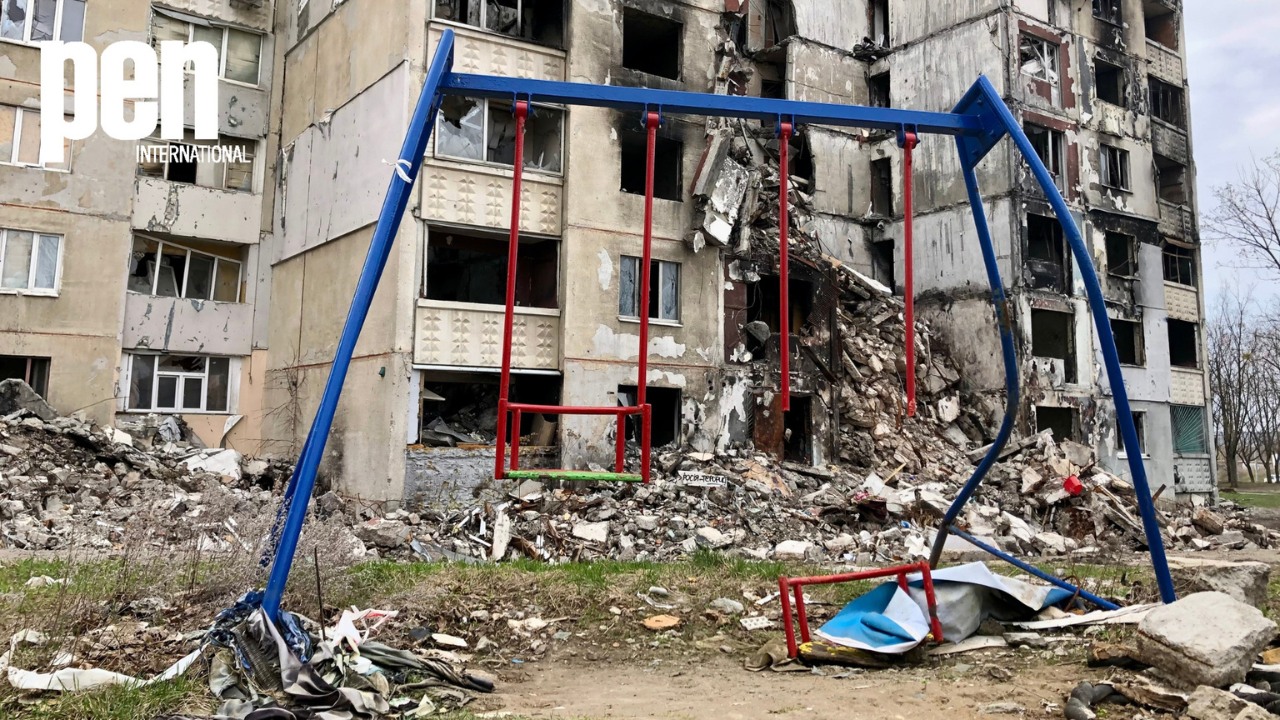
24 February 2026: Today marks four years since the Russian Federation’s full-scale invasion of Ukraine. According to PEN Ukraine and partners, at least 263 cultural figures have been killed by Russian forces. PEN International urges the Russian Federation to immediately end its war of aggression and reiterates calls on the international community to support all efforts to ensure accountability for the people of Ukraine. Perpetrators of human rights violations, war crimes and crimes against humanity must be held to account, and survivors must be provided with full reparations.
PEN International is proud to publish an essay by Volodymyr Yermolenko, President of PEN Ukraine, reflecting on the impact of the Russian Federation’s war against Ukraine.
The opinions expressed in this essay are the author’s own.
*****
Walls of Life
At night, when the drones seem very close, we take the children to the hallway. Since the war began, we’ve been told to follow the ‘two-wall rule’. Stay away from glass – it might injure you. Look for walls – they might save you.
The children bed down on large cushions (instead of mattresses) placed directly on the floor. Sometimes they fall asleep immediately and we hear them snoring. Our girls each sleep with their own melody and rhythm; you can’t mix them up. Sometimes they sit there, hugging their knees to their chest and listening to the darkness. Sometimes they snuggle up to us, trying to slip their little hands into our clothing. As if it were our skin.
Two years ago, the drones were slow. Their engines sounded like mopeds. That’s what Ukrainians nicknamed them: mopeds flying from Russia and bringing death. Now they’re quick, equipped with jet engines. Like cruise missiles. Instinctively you tell yourself you won’t have time to take cover anyway, and you carry on lying in bed. But even in your sleep, your brain forces you to think about your children. So you take them and move them to the hallway. The two-wall rule.
At times in human history, walls have proved destructive. They cut us off from others. They shut certain people out. They are passionately torn down in the name of freedom.
Sometimes the opposite is true, and walls protect us like armour. Find yourself a wall and hang onto it. Otherwise you’ll die.
Sometimes there are too many walls, sometimes too few. History never gives the same answer twice. It’s a wave, a vibration, a string. To understand history you need a good ear.
Four years of large-scale war, twelve years of war in total. Two of our three daughters were born during the war. Our youngest, Yaroslava, has lived half of her life during the full-scale war.
She has paper-thin skin that reveals the lace of her veins. She’s always had the look of a child from another planet. She looks like a little fish. She will swim deep.
In this war the Russian army wants to kill us all. To wipe out hundreds of thousands of people, children and teenagers, babies and pregnant women, adults, the elderly, the strong and the frail. And they are killing us. Ukrainians are too free for them, too convinced that freedom is life itself. ‘Official’ Russian history teaches Russians that freedom means collapse and death, therefore they should hate freedom. Unfortunately, most of them do.
War forces you to think about children again and again. Many people are primarily driven by the desire to protect their children, both those who go to the front and those who take their children and leave the country. Giving birth to new life and preserving it is what keeps us going.
There are many positives in today’s world, but there’s one thing that I don’t like – we’ve lost sight of the miracle of birth. People are so obsessed with their own lives that they are increasingly unwilling to make way for new life. People have forgotten that life is not only valuable in and of itself, but also as a journey along the river towards new life. People have forgotten the metaphysics of old that revolved around birth and conquering death.
We are having fewer children and the wave of time is carrying us into old age. Towards one big waiting room for the dying.
Peaceful societies drift along this slow river of ageing. Predatory societies unleash death to annihilate as much as they can.
Tyrants love death. Tyranny is a thanatocracy – rule by death. Thanatocracy is when you think death is the most effective means of governing. The paradox is that death also wants to live, to squeeze genuine life out of its empire.
Putinism in Russia and Trumpism in America are regimes in love with destruction. They know how to destroy, but they don’t know how to create.
We want to create. We want our children to survive. We want to give birth to more children.
Every month, my wife Tetyana and I travel to the front. We take cars for our soldiers. So far we’ve bought and delivered over fifty. We donated the latest two to some guys who’ve just returned to the army after being wounded. They still laugh and crack jokes, but war has settled in their eyes. Those who have lived through war recognise each other by the look in their eyes.
The roads in frontline towns are increasingly covered with anti-drone nets. Small drones cannot pass through and get tangled in them, just as real birds do. These nets are often fishing nets, sent from all over the world, and sometimes, when driving these roads, you feel as if you’re swimming underwater. Or moving through a kingdom of giant spiders that have enveloped our pathways with their webs. As if they were the true masters of these places.
But the nets can’t protect you from large drones, and occasionally we see burnt-out cars on the road. Some of their passengers survived; others didn’t make it.
This winter has been extremely cold, with temperatures dropping to -20. The Russian army is destroying Ukrainian energy infrastructure, including major power stations that supply electricity and heat. Thousands of blocks of flats in Kyiv (which means hundreds of thousands of people) are without heating. It’s the same in other big cities. If people only have electric stoves at home, they have no way of cooking. This is how the Russian army is punishing Ukrainians for wanting to be free. To be ourselves.
Our children often do their homework by lamplight. War is part of their childlike world. For now, this world is triumphing over war, and they laugh, play and run riot like every other child in the world.
For now, the power of birth is stronger than the power of death and dying in their lives. Will it always be that way? We are fighting for it with every ounce of our strength.
We know that when the drones are flying we have to take the children to the hallway. Find a wall and shelter behind it.
But even where walls no longer exist, there are still people. Ukraine has built a wall with its own bodies. With the bodies and souls of its people. This wall is fragile; it’s not made of bricks. Every soul in it is irreplaceable. Every death is irreversible, forever.
How long will we hold out? We don’t know. As long as we’re still breathing. It’s -20 outside and milk-white vapour escapes from our mouths. Somewhere in the ether, angels breathe out and cover the sky with clouds. Children find the shapes of their favourite animals in them.
Their world, their childlike world, has to triumph in the end.
By Volodymyr Yermolenko
Translated by Helena Kernan
*****
Стіни життя
Вночі, коли нам здається, що дрони летять зовсім близько, ми переносимо дітей у коридор. Ще від початку війни нас учили дотримуватися правил двох стін. Уникайте близькості до скла, воно може поранити; шукайте стін, вони можуть захистити.
Діти лягають на великі подушки (замість матраців) прямо на підлогу. Інколи вони одразу засинають, і ми чуємо їхні сопіння: у кожної з наших дівчат мелодія і ритміка сну своя, ніколи не сплутаєш. Інколи вони сидять, обійнявши коліна руками, і вслухаються в темряву. Інколи притуляються до нас, намагаючись проникнути своїми рученятами під наш одяг. Наче під шкіру.
Два роки тому дрони летіли повільно, звук їхніх моторів нагадував мопеди. Так українці їх і прозвали: мопеди, що летять з Росії і несуть смерть. Зараз вони летять швидко, оснащені реактивними двигунами. Вже як крилаті ракети. Несвідомо ти кажеш собі, що все одно не встигнеш сховатися. І ти би лежав у своєму ліжку й далі, але навіть уві сні мозок наказує думати про дітей. І ми беремо їх і переносимо у коридор. Правило двох стін.
Інколи в людській історії стіни є згубними. Вони затуляють нас від інших. Вони залишають когось поза межами. Їх пристрасно руйнують у пошуках свободи.
Інколи навпаки, стіни стають нашою бронею. Знайди свою стіну і тримайся за неї. Інакше загинеш.
Інколи стін забагато, інколи замало. Історія ніколи не дає однакових відповідей. Це хвиля, вібрація, струна. Для розуміння історії потрібен слух.
Чотири роки великої війни, дванадцять років війни загалом. Двоє з трьох наших доньок народилися під час війни. Найменша, Ярослава, прожила половину свого життя у великій війні.
У неї тонесенька шкіра, за якою видно мереживо вен; у неї завжди був погляд дитини з іншої планети. Вона схожа на маленьку рибку. Вона плаватиме глибоко.
У цій війні російська армія хоче нас усіх вбити. Знищити життя сотень тисяч людей, дітей і підлітків, немовлят і вагітних, дорослих, старих, міцних і крихких. І вона вбиває. Украінці для неї занадто вільні, і занадто вірять у те, що свобода – це життя. Російська ж “офіційна” історія вчить росіян, що свобода – це розпад і смерть. Тому свободу треба ненавидіти. На жаль, більшість із них так і робить.
Війна змушує знову й знову думати про дітей. Прагнення захистити своїх дітей є головною мотивацією багатьох – як тих, хто йде на фронт, так і тих, хто бере своїх дітей і їде з ними за кордон. Народження нового буття і збереження його: це нас тримає.
Є багато хороших речей у сучасному світі, але є річ, яка мені не подобається: ми знецінили таємницю народження. Люди занадто закохані в свої життя, і все рідше дають дорогу життю новому. Люди забули, що життя цінне не лише саме по собі, а й як подорож рікою до життя нового. Люди забули давню метафізику, яка була так зосереджена на народженні і подоланні смерті.
Ми стали менше народжувати, а тому хвиля часу нас несе у стан старців. У великий будинок для помирання.
Мирні суспільства течуть цією повільною рікою старіння; хижі суспільства вивільняють смерть, щоб збільшити небуття.
Тирани люблять смерть. Тиранія – це танатократія, правління через смерть. Танатократія – це коли ти вважаєш смерть найкращим інструментом управління. Парадокс у тому, що смерть теж хоче жити – і вичавлювати справжнє життя з його володінь.
Путінізм у Росії, трампізм в Америці – це сили, закохані у знищення. Вони знають, як руйнувати, але не знають, як створювати.
А ми хочемо створювати. Ми хочемо, щоб наші діти вижили. Ми хочемо, щоб народжувалося більше дітей.
Щомісяця ми з моєю дружиною Тетяною їздимо на фронт. Ми веземо автівки для наших військових. Ми вже купили і відвезли понад пʼятдесят. Дві останні ми передали хлопцям, які повернулися до війська після поранень. Вони все одно жартують і посміхаються, але в їхніх очах оселилася війна. Ті, хто пройшов крізь війну, впізнають один одного за поглядом.
Дороги прифронтових міст все більше вкривають антидроновими сітками. Малі дрони їх не подолають і заплутаються – як заплутуються в них справжні птахи. Сітки ці часом рибальські, їх надсилають з усього світу, і часом на цих дорогах в тебе враження, що ти пливеш під водою. Або просуваєшся володіннями величезних павуків, які обплели наші шляхи своїм павутинням. Немов справжні володарі цих місць.
Але від великих дронів сітки не захищають, і час від часу ми бачимо на дорозі спалені машини. У них були люди, хтось урятувався, а хтось не встиг.
Зима цього року дуже холодна, температура падає до -20. Російська армія знищує українську енергетику, великі теплоелектростанції, що подають струм і тепло. Тисячі багатоквартирних будинків у Києві – а значить сотні тисяч людей – живуть без опалення у своїх квартирах. Те саме в інших великих містах. Якщо їхні квартири мають лише електроплити, то їм ще й нема на чому приготувати їжу. Так російська армія карає українців за їхнє бажання бути вільними. Бути собою.
Наші діти часто роблять уроки під світлом пересувних ламп. Війна – частина їхнього дитячого світу. Поки що цей світ війну перемагає, і вони сміються, граються і бешкетують, як і всі інші діти в усьому світі.
Поки що в їхніх життях сили народження сильніші за сили вмирання та смерті. Чи так буде завжди? Ми боремося за це з усіх сил.
Ми знаємо, що коли летять дрони, дітей треба нести в коридор. Знайти свою стіну і сховатися за неї.
Але там, де не лишилося стін, залишаються люди. Україна створила стіну зі своїх власних тіл. З тіл і душ своїх людей. Ця стіна крихка, вона не з каміння. Кожна душа в ній незамінна. Кожна смерть – це неповернення, назавжди.
Як довго ми протримаємося? Ми не знаємо. Поки ми дихаємо. На вулиці -20, і біла, як молоко, пара злітає з наших губ.
Десь у небі дихають янголи, і вкривають небеса хмарами. Діти впізнають у них улюблених тварин.
Їхній, дитячий, світ має нарешті перемогти.
Володимир Єрмоленко
Note to editors:
For further details contact Aurélia Dondo, Head of Europe and Central Asia Region at PEN International: [email protected]
For media queries, please contact Sabrina Tucci, Head of Communications and Campaigns at PEN International: [email protected]